
When comparing Google Ads vs Facebook Ads for small business, neither platform produces better ROI in every situation. Google Search is strongest when people are already looking for a product or service. Facebook and Instagram ads are often stronger when the business must create interest, demonstrate an offer visually or reach potential customers before they search.
The best choice in 2026 depends on five things: existing demand, buying cycle, creative strength, conversion tracking and unit economics. Many businesses ultimately use both—Meta to introduce or remind, and Google to capture active intent—but a small budget should not be divided automatically. This guide shows how to choose, test and measure each platform.
The Core Difference: Capturing Demand vs Creating Demand
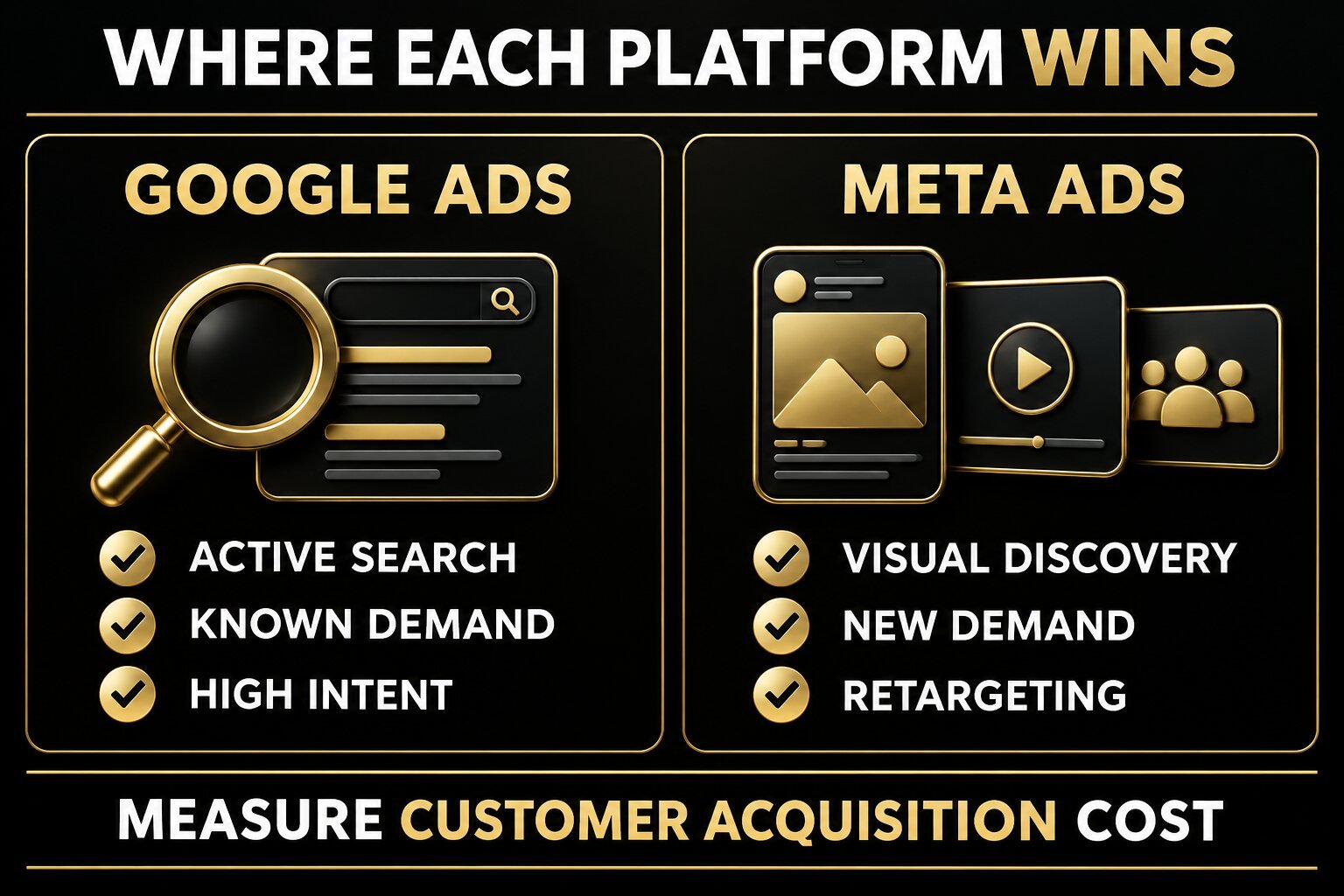
Google’s Search campaign guidance says Search ads can reach people actively searching for the products and services you offer. A user who searches “emergency plumber near me” or “WordPress web designer for small business” is expressing a need in words. The advertiser competes to appear at that moment.
Meta ads appear while people use Facebook, Instagram, Messenger and related placements. The user may not be searching for your category, so the creative and offer must interrupt attention and create relevance. Meta provides objectives for awareness, traffic, engagement, leads, app promotion and sales; its official ad objectives guide recommends choosing the outcome that matches the business goal.
This “capture vs create” distinction is useful, but not absolute. Google also offers YouTube, Display, Demand Gen, Shopping and Performance Max. Meta can retarget high-intent visitors and optimise for purchases or qualified leads. Compare the specific campaign strategy—not merely the company names.
Google Ads vs Facebook Ads: Quick Comparison
| Decision factor | Google Ads | Facebook & Instagram Ads |
|---|---|---|
| Typical starting strength | Capturing existing search intent | Generating awareness, consideration and visual discovery |
| User context | Searching, researching, comparing or shopping | Browsing feeds, Stories, Reels and messages |
| Targeting foundation | Queries, keywords, products, audiences and real-time intent | Conversion signals, audiences, engagement and creative response |
| Creative demand | Search can begin with text; other campaigns need more assets | Strong images and video are central to most placements |
| Best for | Known demand, urgent needs and specific comparisons | Visual offers, discovery, storytelling and retargeting |
| Common failure | Paying for broad or irrelevant searches | Attracting attention without purchase intent |
| ROI risk | High CPC without strong conversion economics | Cheap clicks or leads that do not become customers |
When Google Ads Is More Likely to Win
1. The customer has an urgent or specific need
Search is a natural fit for services people actively request: repairs, legal help, healthcare appointments, local trades, business software, specialist consulting and high-consideration purchases. The query can reveal location, problem and urgency, allowing the ad and landing page to respond directly.
2. Search volume already exists
If potential customers already know the category and search using commercial terms, Google can capture that demand efficiently. Keyword Planner and account search-term data can estimate whether enough relevant traffic exists. A new or unfamiliar product with little search demand may struggle even with excellent ads.
3. The offer is easier to express with intent than imagery
Some buyers care more about availability, expertise, location or a precise capability than an emotional visual. A well-structured Search campaign can match a detailed query to a focused service page without requiring a constant stream of videos.
4. The business needs controlled keyword learning
Search-term reporting can reveal how customers describe their problems and which queries produce qualified demand. That intelligence can improve service pages, SEO and future creative. The account still needs negative keywords, relevant ads and correct conversion goals; intent does not guarantee profitability.
When Facebook and Instagram Ads Are More Likely to Win
1. The product is visual, demonstrable or emotionally distinctive
Fashion, beauty, food, home products, events, fitness, creative services and transformations can often communicate value faster through imagery or video. Reels, Stories and feed placements let a business demonstrate the problem, product and outcome before the person has searched for it.
2. The audience can be reached before active search
A new category or discretionary product may have limited search volume. Meta can expose the offer to likely buyers, then learn from engagement and conversion signals. Meta describes Advantage+ audience as an AI-powered way to match campaigns with relevant people, while advertisers provide audience suggestions and controls.
3. Retargeting and creative sequencing matter
Meta can remind visitors, product viewers, engaged users and existing customers with a new proof point, demonstration or offer. This is useful when the decision takes several interactions. Respect consent and platform policies, and exclude customers when repeat purchase is not the goal.
4. The business can produce and test strong creative
On social platforms, creative is a targeting and qualification tool. It determines who stops, what they understand and why they click. Build concepts for each placement rather than stretching one generic square graphic across every format. See our guide to social media ad design for clicks and conversions.
Which Platform Fits Different Small Businesses?
| Business or offer | Likely first test | Reason |
|---|---|---|
| Emergency local service | Google Search | High urgency and explicit location intent |
| Specialist B2B service | Google Search, then Meta retargeting | Specific problem searches plus a longer decision cycle |
| Visual direct-to-consumer product | Meta Sales, supported by Google Shopping/Search | Creative discovery plus capture of product and brand searches |
| New product category | Meta awareness or sales test | Demand may need to be created before it can be searched |
| High-intent software comparison | Google Search | Buyers often research features, alternatives and pricing |
| Workshop, event or local experience | Meta plus brand Search protection | Visual story, local reach and time-sensitive promotion |
| Repeat-purchase online shop | Both, measured by contribution and lifetime value | Discovery, remarketing, product intent and repeat economics all matter |
This table is a starting hypothesis, not a rule. Actual performance depends on market competition, offer strength, page quality and data. A “perfect platform fit” still fails when the promise, destination or measurement is weak.
Do Not Compare Click Costs—Compare Profitable Customer Acquisition
Facebook clicks may cost less than Google clicks, but a cheap visitor can still be expensive if few buy. Google clicks may cost more because the user is closer to action, but high CPC can destroy margin in a competitive auction. ROI should be calculated from qualified business outcomes.
Customer acquisition cost = advertising spend ÷ new customers attributed to the campaign
Contribution return = contribution generated from those customers ÷ advertising spend
For lead generation, also track cost per qualified lead, lead-to-sale rate, sales-cycle length and acquired customer value. If Meta produces £20 leads and Google produces £60 leads, Meta is not automatically better. If 10% of Meta leads close and 50% of Google leads close, the estimated acquisition costs are £200 and £120 respectively.
Why Platform ROAS Can Mislead You
A customer may see a Facebook video, later search the brand on Google, click a Search ad and then purchase. Meta and Google can each credit that order under their own attribution rules. A last-click analytics report may give Google all the credit; a view-through report may give Meta influence. Adding platform numbers together can therefore overstate total revenue.
- Use consistent UTMs and verify revenue or lead IDs in a source-of-truth system.
- Compare platform attribution windows rather than assuming the defaults match.
- Separate brand Search from non-brand acquisition where possible.
- Track blended acquisition cost: total paid media divided by total new customers.
- Watch whether Meta spend changes direct traffic, branded search and assisted conversions.
- Use incrementality or controlled geographic tests when spend and data justify them.
Google explains that data-driven attribution assigns credit based on account conversion paths across eligible Google ad interactions. Meta has its own attribution settings. Neither replaces order data, CRM quality or a clear definition of a new customer.
A Practical Testing Plan for a Limited Budget
1. Pick one business outcome
Choose a purchase, qualified enquiry, booked appointment or another outcome close to revenue. Configure platform and analytics tracking before launch, then test it end to end.
2. Match the first platform to the demand state
If buyers already search frequently for the offer, begin with a narrow Google Search test. If the product needs demonstration or has little existing search demand, begin with Meta creative and a sales or leads objective. Do not split a very small budget merely to say both channels are active.
3. Set a budget from CPA economics
Estimate CPC, conversion rate and acceptable acquisition cost, then fund enough traffic to learn. Our guide to small-business Google Ads budgets includes a step-by-step formula and worked scenarios.
4. Build channel-native ads
For Search, group related intent and write ads that match the query and landing page. For Meta, create several distinct visual concepts in appropriate aspect ratios. Keep the offer and destination consistent enough that you can diagnose results.
5. Fix the landing page before scaling either platform
The first screen should confirm the offer, audience, value and next action. Check mobile speed, forms, checkout, trust signals and total cost. These landing-page conversion mistakes can waste high-intent Search clicks and visually qualified social traffic alike.
6. Compare a decision-ready scorecard
| Metric | Why it belongs in the decision |
|---|---|
| Spend and media delivery | Confirms each test had a real opportunity to perform |
| Landing-page views or engaged sessions | Separates ad delivery from page-load failure |
| Primary conversions | Measures the chosen business action |
| Qualified-lead or order rate | Filters out spam, cancellations and low-value actions |
| Customer acquisition cost | Connects platform performance to acquired customers |
| Contribution and payback period | Shows whether growth is financially sustainable |
| Assisted and blended performance | Captures interaction between channels |
Common Mistakes When Choosing Between Google and Meta
- Choosing the platform with the cheapest clicks.
- Running Traffic campaigns when the real goal is sales.
- Sending every ad to the home page.
- Using one creative in every Meta placement.
- Ignoring negative keywords and search terms in Google.
- Counting all leads as equal without checking sales quality.
- Scaling spend before Pixel, Google tag, CRM or purchase values are verified.
- Comparing two platforms with different offers, dates or attribution windows.
- Declaring a winner before the normal sales cycle has elapsed.
If Facebook or Instagram receives clicks without revenue, work through our diagnostic guide: why Facebook ads get clicks but no sales.
Frequently Asked Questions
Are Facebook Ads cheaper than Google Ads?
They may produce a lower CPM or CPC in some markets, but that does not make customer acquisition cheaper. Compare qualified conversions, closed customers, contribution and payback period. Auction costs vary by country, audience, industry, season and campaign quality.
Which platform is better for local service businesses?
Google Search is often the logical first test when people actively search for the service by location or urgency. Meta can support awareness, retargeting and offers that require explanation. The final decision should use local search volume and lead quality.
Which is better for e-commerce?
Both can work. Meta is strong for visual discovery, product demonstration and dynamic remarketing; Google Shopping, Search and Performance Max can capture product and brand intent across Google. Feed quality, creative, margin, repeat purchase and tracking determine the profitable mix.
Can a small business run both with a small budget?
Yes, but only if each test can receive enough spend to produce useful evidence. Concentrating on one channel and one offer is often more informative than keeping several underfunded campaigns active. Add the second platform after the first funnel and measurement system are understandable.
Final Verdict: Let Demand and Economics Choose
In the debate over Google Ads vs Facebook Ads for small business, Google is usually the stronger first choice for active, specific demand; Meta is usually the stronger first choice for visual discovery, demand creation and social retargeting. The better ROI comes from the platform that can acquire the right customer below a sustainable cost—not the platform with the lowest click price.
The Visual Spark helps businesses connect media strategy with conversion-focused creative, copy and landing pages. Explore our digital marketing services, improve campaign messaging with content and copywriting, view all creative services or contact us for a practical paid-media plan.
Leave A Comment