

A website redesign checklist helps you decide whether your business site needs a complete rebuild, a focused refresh or a few carefully chosen fixes. An outdated website does more than look old: it can confuse visitors, weaken trust, slow down lead generation and make every future marketing campaign harder to run.
The right time to redesign is not determined by age alone. A three-year-old website may still perform well, while a recently launched site can already be holding a business back. The useful question is whether the website still supports your brand, customers, search visibility and commercial goals. Use the ten warning signs below to make that decision with evidence rather than personal preference.
What Is a Website Redesign?
A website redesign is a substantial improvement to a site’s structure, user experience, visual system, content or technology. It may include new page architecture, responsive layouts, clearer messaging, faster code, conversion-focused journeys and a more manageable content system. It should solve business and user problems—not simply replace one visual trend with another.
A refresh usually changes selected elements such as colours, typography, imagery or a small number of page layouts. A redesign goes deeper when navigation, templates, content hierarchy, performance or platform limitations need attention. The Visual Spark’s professional website design service connects those decisions so the finished site looks credible and works as a practical business tool.
Website Redesign Checklist: 10 Signs It Is Time for an Update
1. Your website no longer reflects the business
Your services, audience, positioning or brand may have changed while the website stayed frozen in the past. Warning signs include discontinued services in the main navigation, old team information, mismatched visual styles and a homepage that describes a company you have outgrown.
Compare the live site with your current offer and brand style guide. If visitors cannot quickly understand what you do now, who you help and why you are different, a redesign can realign the experience around the current business.
2. The mobile experience feels difficult or incomplete
A responsive layout must do more than shrink desktop pages. Text should remain readable, buttons should be easy to tap, forms should be practical to complete and important content should appear in a sensible order. Horizontal scrolling, overlapping elements and slow mobile menus are clear redesign signals.
Mobile quality also affects search visibility. Google explains in its mobile-first indexing guidance that it uses the mobile version of a site’s content for indexing and ranking. Test representative pages on real phones, not only inside a desktop preview.
3. Pages are slow or Core Web Vitals are poor
Heavy images, excessive scripts, old themes and overloaded page builders can make a site feel unresponsive. Visitors notice delays when the main content appears slowly, the page moves while loading or buttons do not react promptly.
Use PageSpeed Insights and Search Console as diagnostic tools, then interpret results alongside real user behaviour. The official Web Vitals guidance defines metrics for loading performance, responsiveness and visual stability. Individual optimisations may be enough, but a redesign becomes sensible when performance problems are built into the theme, components or content workflow.
4. Visitors struggle to find the right information
Navigation should match the questions customers bring to the site. A crowded menu, vague labels, duplicate pages and hidden contact routes force users to work too hard. If prospects regularly ask for information that already exists online, the structure or wording is probably failing.
Review common journeys: homepage to service, service to proof, proof to enquiry and article to next step. A redesign can group related pages, clarify labels, improve internal search and create a more deliberate hierarchy. Our guide to essential business website features provides a useful baseline for what modern visitors expect.
5. Relevant traffic arrives, but conversions remain weak
Traffic without enquiries, bookings or sales often points to a gap between visitor intent and the page experience. The offer may be unclear, proof may appear too late, calls to action may compete with one another or forms may ask for too much information.
Check analytics by landing page, device and traffic source before assuming the entire site is at fault. Heatmaps, form completion data and sales feedback can reveal the real friction. The same principles covered in our guide to landing page design mistakes apply across service pages: make the next step obvious, credible and low-friction.
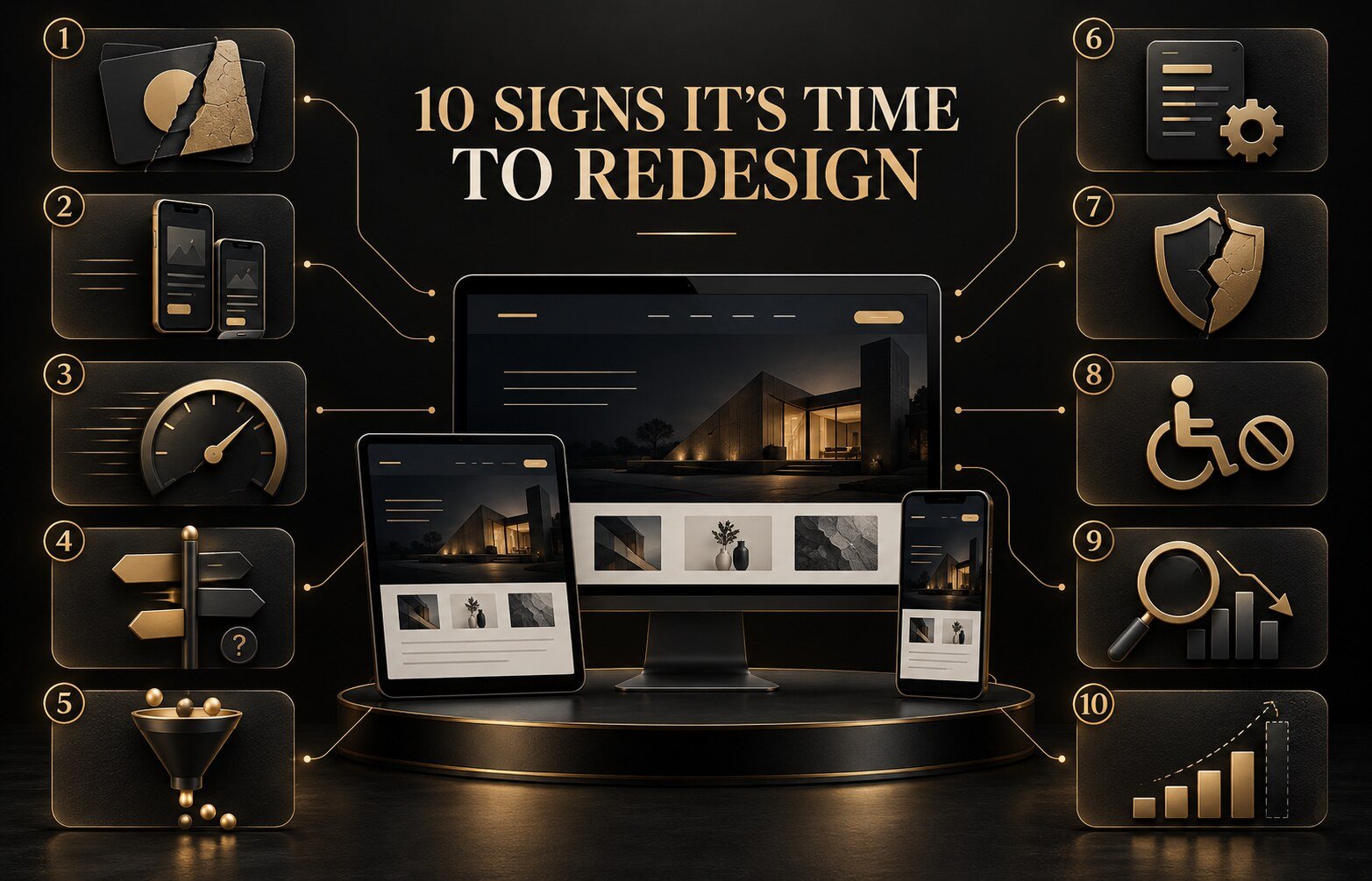
6. Publishing and updating content is unnecessarily difficult
A business website should not require a developer for every text edit, image replacement or new case study. Brittle templates, inconsistent page builders and unclear permissions create delays and encourage teams to leave outdated content live.
A redesign can introduce reusable page sections, controlled design options, clear content fields and an agreed publishing workflow. The goal is not unlimited editing freedom; it is a system that lets authorised people update routine content without breaking brand consistency, accessibility or layout quality.
7. The design creates doubt instead of trust
Visitors form an impression before they read every claim. Low-quality images, inconsistent typography, broken sections, obsolete copyright dates and layouts associated with another era can make a legitimate business feel neglected. Inconsistent design also makes it harder to recognise the brand across ads, social media and proposals.
A redesign should strengthen trust with disciplined visual hierarchy, authentic proof, readable content and consistent components. It should not hide weak messaging beneath decoration. If the value proposition itself needs work, pair the design process with professional website copywriting.
8. The site has important accessibility barriers
Low colour contrast, missing keyboard focus, unlabelled form fields, poor heading structure and meaningful images without alternatives can prevent people from using a site. Accessibility is not a finishing touch; it influences design, content and development decisions from the beginning.
Use the W3C’s current Web Content Accessibility Guidelines as the technical reference and test key tasks with keyboards, screen readers and zoom. Some defects can be repaired individually. A redesign is appropriate when inaccessible patterns repeat across the template system.
9. Technical SEO problems are limiting growth
Search performance can be restricted by duplicate pages, confusing URL structures, thin templates, poor internal linking, missing headings or content that search engines cannot reliably access. A redesign can resolve structural causes, but it can also damage existing visibility if migration work is careless.
Before changing URLs or templates, inventory pages that already earn traffic, links and conversions. Map every retired URL to its closest useful replacement, preserve valuable content and validate indexing after launch. Use our SEO-friendly website design checklist to bring search requirements into the project before visual concepts are approved.
10. The website cannot support your next stage of growth
A site may work for today but fail every time the business adds a service, location, language, integration or campaign. Repeated workarounds, disconnected forms, manual data entry and plugins added without a plan are signs that the underlying system has reached its limit.
Define the capabilities you expect over the next two to three years, then separate genuine requirements from speculative features. A scalable redesign uses flexible content models and integrations without making the first release unnecessarily complex. Budgeting should include strategy, content, development, testing and post-launch support; our guide to small business website costs explains the factors that influence investment.
Do You Need a Full Redesign or a Focused Refresh?
Choose a focused refresh when the structure, platform and main user journeys work well but selected visuals or content have become dated. Consider a full redesign when several warning signs share the same root cause—for example, an inflexible theme causing slow performance, inconsistent layouts, difficult editing and poor mobile behaviour.
Start with an audit rather than a mood board. Review analytics, search data, technical performance, customer questions, brand alignment and content quality. Rank problems by commercial impact and user impact. This keeps the project focused on measurable improvements instead of subjective likes and dislikes.
Pre-Redesign Checklist: Protect Performance and SEO
- Record current traffic, rankings, enquiries, sales and other conversion benchmarks.
- Crawl the existing site and export all indexable URLs, titles, descriptions and status codes.
- Identify high-performing pages, valuable backlinks and content that must be preserved.
- Map the new information architecture and create one-to-one 301 redirects where URLs change.
- Define the audience, priority journeys, content responsibilities and success measures.
- Build and review the new site in a protected staging environment.
- Test mobile layouts, accessibility, forms, payments, integrations and analytics tracking.
- Compress images and check performance on representative templates and real devices.
- Confirm canonical tags, robots directives, XML sitemaps and structured data before launch.
- Create a backup, launch checklist and rollback plan, then monitor errors and conversions after release.
Frequently Asked Questions
How often should a business redesign its website?
There is no reliable fixed interval. Review the website regularly and redesign when evidence shows that the brand, user experience, technology or business goals have outgrown it. Performance matters more than the date it launched.
Can a website redesign hurt SEO?
Yes, if valuable content disappears, URLs change without suitable redirects, internal links break or the new site blocks crawling. A planned migration can reduce risk and may improve visibility when it resolves genuine technical and content problems.
How long does a website redesign take?
Timing depends on page count, content readiness, integrations, feedback cycles and testing needs. A focused small-business project may take several weeks, while a complex migration can take months. Clear decisions and prepared content usually save more time than rushing design or testing.
What should be measured after a redesign?
Compare qualified traffic, engagement, form completion, sales, mobile performance, Core Web Vitals and search visibility with the pre-launch baseline. Monitor by page and device so improvements or problems are not hidden inside an overall average.
Turn the Redesign Into a Business Improvement
A strong website redesign improves how people understand, trust and act on your offer. If several items on this website redesign checklist describe your current site, begin with a structured audit and prioritise the problems that affect customers and revenue most.
The Visual Spark is a UK-based creative studio serving businesses worldwide with website design, branding, graphic design, content and digital marketing support. Explore our creative services or contact The Visual Spark to plan a business website redesign built around clear goals, strong user experience and sustainable growth.
Leave A Comment