

How much should a small business spend on Google Ads? There is no universal minimum or ideal monthly figure. A useful budget is large enough to buy a meaningful number of relevant clicks and conversions in your market, but low enough that the business can afford the learning period. The right number comes from expected cost per click, website conversion rate, lead quality, profit and the number of customers you want—not from a generic industry average.
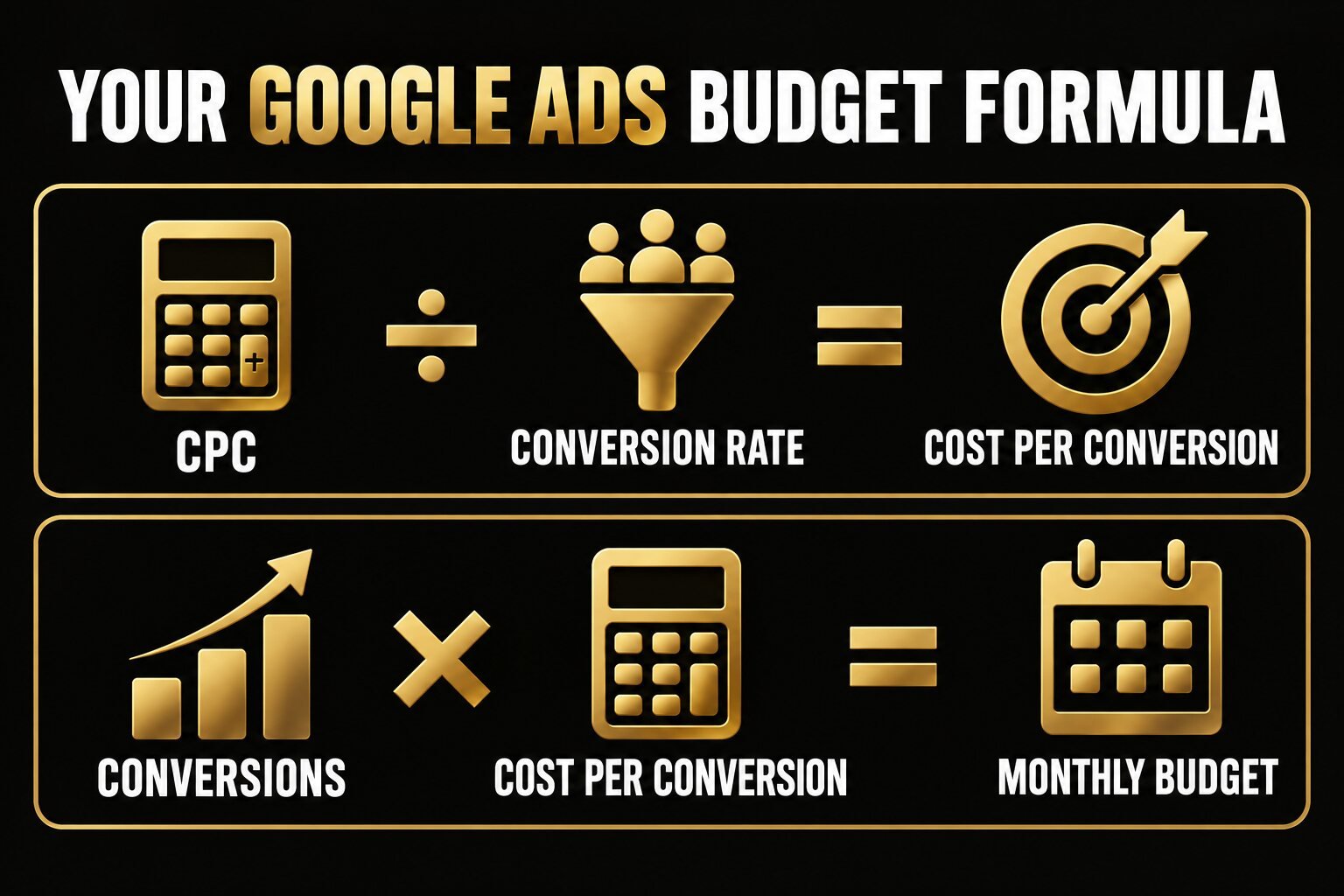
A practical 2026 planning formula is:
Monthly media budget = desired monthly conversions × workable cost per conversion
For lead generation, take the calculation one step further because a lead is not yet a customer. If a £40 lead becomes a customer 25% of the time, the estimated customer acquisition cost is £160. Whether that is sustainable depends on gross profit, repeat purchases, fulfilment costs and cash flow.
The Short Answer: Start With Economics, Not a Random Daily Budget
| Question | Number you need | Why it matters |
|---|---|---|
| What does one click cost? | Expected CPC | Shows how much traffic the budget may buy |
| How many visitors convert? | Website conversion rate | Turns CPC into an estimated CPA or CPL |
| How many leads become customers? | Lead-to-sale rate | Turns cost per lead into acquisition cost |
| What can one customer generate? | Gross profit or contribution margin | Defines the maximum sustainable acquisition cost |
| How many results are required? | Monthly conversion goal | Determines the working media budget |
If these inputs are unknown, the first campaign is a controlled research investment. Its job is to generate enough trustworthy data to replace assumptions with account-specific numbers.
How Google Ads Daily and Monthly Budgets Work
Google Ads normally asks for an average daily budget at campaign level. Google explains that the monthly spending limit for most campaigns is the average daily budget multiplied by 30.4. A campaign with a £20 average daily budget therefore has a typical monthly spending limit of £608.
Daily spend is not always exactly the number entered. Google’s average daily budget guidance says that, for most campaigns, an individual day can spend up to two times the average daily budget when traffic is stronger, while the monthly limit remains 30.4 times the average daily amount. Review the official spending limits before setting cash-flow expectations.
That means a “£20 per day” campaign should be planned as approximately £608 per month—not as a promise that every day will stop at exactly £20.
A Six-Step Google Ads Budget Calculator
1. Define the conversion that creates business value
Choose the action the campaign is expected to produce: an online purchase, qualified enquiry, booked consultation, phone call, trial or store visit. Do not treat every button click as equal. Configure conversion measurement before launch and mark only meaningful actions as primary optimisation goals.
2. Calculate the maximum workable acquisition cost
Start with contribution, not revenue. Subtract product or service delivery costs, payment fees, returns, sales commission and other variable costs. Decide how much of the remaining value can fund acquisition while leaving an acceptable profit.
For lead generation:
Maximum cost per lead = maximum customer acquisition cost × lead-to-customer rate
If a customer is worth £600 in contribution, you are prepared to invest £180 to acquire one, and 20% of qualified leads close, the maximum workable CPL is approximately £36. This is an internal business decision, not a promise that the market will supply leads at that price.
3. Estimate click costs with Keyword Planner
Google’s Keyword Planner can discover keywords and provide search-volume and forecast information. Build the plan around the actual service, location and commercial intent you will target. A national “insurance” query and a local “emergency plumber near me” query can have radically different auctions.
Treat forecasts as planning inputs, not guaranteed prices. Actual CPC changes with competition, location, device, seasonality, relevance, bidding and account performance. Use a range rather than one exact estimate.
4. Estimate the website conversion rate
If analytics already separates paid-search traffic, use that history. Otherwise, model a conservative low case, a realistic case and a strong case. Then calculate:
Estimated cost per conversion = average CPC ÷ conversion rate
At a £2.50 CPC and a 4% conversion rate, the estimated cost per lead or sale is £62.50. If the page converts at only 2%, the estimate doubles to £125. This is why improving the destination can change the affordable ad budget more than chasing a slightly cheaper click. Review these landing-page design mistakes before paying for scale.
5. Choose a conversion volume worth testing
A budget that can buy only a few clicks in a competitive auction will not answer much. Define a test around the number of relevant visits or business outcomes required to evaluate the offer. The right volume depends on the normal conversion rate, sales cycle and value of the decision; a high-volume online shop and a specialist B2B service should not use the same expectation.
Rather than choosing an arbitrary seven-day test, set a spend and evidence threshold. For example: “Run until the campaign has generated enough landing-page visits to evaluate the expected conversion rate, or until spend reaches the pre-approved learning budget.” Also monitor useful intermediate actions so a complete absence of engagement can be diagnosed early.
6. Convert the monthly plan into an average daily budget
If the plan calls for 12 conversions at an estimated £62.50 each, the working monthly media budget is £750. Dividing by 30.4 gives an average daily budget of approximately £24.67. Round the operational number sensibly and maintain a cash reserve for normal daily variation.
Three Illustrative Small-Business Budget Scenarios
These examples show the calculation method only. They are not forecasts or recommended prices for every account.
| Scenario | Planning assumptions | Estimated outcome | Illustrative monthly spend |
|---|---|---|---|
| Local service leads | £3.50 CPC; 8% visitor-to-lead rate; 30% lead-to-customer rate | £43.75 CPL; about £145.83 acquisition cost | About £729 for five customers |
| Online shop | £0.90 CPC; 2.5% purchase rate | About £36 cost per purchase | About £720 for 20 purchases |
| Specialist B2B service | £8 CPC; 5% visitor-to-lead rate; 20% close rate | £160 CPL; about £800 acquisition cost | About £1,600 for two customers |
The e-commerce example still needs a margin test. If an order produces only £25 in contribution, a £36 acquisition cost is not sustainable on the first sale unless repeat purchase value, upsells or other economics justify it. The B2B example may be highly profitable if a new client contributes several thousand pounds, but unacceptable if the average project is small.
How to Allocate a Limited Google Ads Budget
A small budget becomes weaker when split across too many services, locations and campaign types. Start with the offer that combines strong intent, a credible landing page and healthy economics. A simple working allocation can reserve most of the spend for proven demand, a smaller portion for controlled tests and a small exploratory portion for new queries or creative. The percentages should change as evidence grows.
- Prioritise: the service, product or location with the clearest conversion path.
- Protect: high-intent and brand demand where it is valuable.
- Test: one meaningful variable at a time—query coverage, ad message, page or campaign feature.
- Exclude: irrelevant searches and locations rather than paying to relearn obvious waste.
- Reallocate: according to qualified leads, revenue and margin, not only clicks.
Campaign choice also affects budget use. Standard Search, Search with AI Max and Performance Max have different reach, control and creative requirements. Read our comparison of AI Max vs Performance Max vs Search campaigns before spreading a modest budget across every option.
Signs Your Google Ads Budget Is Too Low
- One or two typical clicks can consume the average daily amount.
- The campaign repeatedly shows a “Limited by budget” status for valuable demand.
- Several campaigns each receive too little traffic to evaluate.
- The budget cannot support the conversion goal implied by the target CPA.
- Decisions are being made from isolated clicks rather than patterns.
“Limited by budget” does not automatically mean the business should spend more. It means the current average daily budget is below Google’s estimate for capturing all available traffic under the settings. Increase spend only if the additional demand is relevant and the economics support it.
Signs the Business Is Spending Too Much Too Soon
- Conversion tracking has not been tested end to end.
- Sales, spam and low-quality enquiries are counted as the same result.
- The landing page is slow, generic or mismatched to the ad.
- Search terms and location reports are not being reviewed.
- Budget is increasing faster than qualified demand or operational capacity.
- The business cannot explain the maximum profitable acquisition cost.
Automation can spend an available budget efficiently according to the signal it receives, but it cannot decide whether the underlying signal represents profit. Google’s Target CPA guidance explains that the strategy aims for conversions around a desired average CPA; individual results can still cost more or less.
Separate Media Spend From the Full Advertising Cost
The Google Ads budget is only the amount paid to the platform. A complete plan may also include campaign strategy and management, conversion tracking, feed management, landing-page design, copywriting, creative assets and call-tracking or CRM tools. Keep these costs visible so the business evaluates true return rather than media ROAS alone.
Some of these investments improve more than one campaign. A well-built business website, clearer conversion copy and reusable brand assets can support organic, paid and referral channels together.
How to Adjust the Budget After Launch
- Verify the conversion data against real orders or qualified leads.
- Separate brand and non-brand results where their economics differ.
- Review search terms, locations, devices and hours for avoidable waste.
- Improve ads and landing pages before assuming more budget is the only answer.
- Use account-specific forecasts and, when eligible, Google’s Performance Planner to model possible changes.
- Scale when marginal spend still produces acceptable business outcomes and operations can fulfil the demand.
Frequently Asked Questions
Is £10 per day enough for Google Ads?
It can be enough for a narrow test in a lower-cost market, but it may buy too few clicks in a competitive service category. Compare the daily amount with expected CPC and conversion rate. At a £5 CPC, £10 per day may average only two clicks; that is unlikely to create fast learning.
What is the minimum monthly Google Ads budget?
Google does not provide one universal minimum that makes every campaign viable. The practical minimum is the amount needed to reach a meaningful volume of relevant auctions and evaluate the chosen conversion goal without creating unacceptable financial risk.
Should I use Google’s recommended budget?
Treat it as a platform forecast of available traffic, not an instruction about profitability. Compare the recommendation with search quality, conversion rate, margin, capacity and cash flow. More available traffic is valuable only when the additional results are commercially useful.
How long should a small business test Google Ads?
Use a predefined evidence and spend threshold rather than a universal number of days. The period must account for click volume, conversion delay and the sales cycle. A local emergency service may learn quickly; a high-value B2B offer may need weeks or months to connect leads with closed revenue.
Build a Budget the Business Can Defend
The best answer to “how much should a small business spend on Google Ads?” is a defendable range built from expected CPC, conversion rate, close rate and contribution margin. Start with one clear goal, fund enough traffic to learn, protect the downside with a pre-approved limit and scale only when real customers—not dashboard activity—justify it.
The Visual Spark helps small businesses align advertising with the landing pages, copy, tracking and creative required to convert demand. Explore our digital marketing services, view all creative services or contact us to plan a campaign around measurable business economics.
Leave A Comment