
Choosing between AI Max vs Performance Max vs Search campaigns is not really a choice between three identical Google Ads products. Standard Search is a campaign type built around search intent and advertiser-defined structure. AI Max is an optional AI-powered optimisation layer inside a Search campaign. Performance Max is a separate, goal-based campaign type that can serve across Google’s full advertising inventory.
For most small businesses, the practical answer in 2026 is: start with accurate conversion tracking and a tightly structured Search campaign; test AI Max when you are ready to expand beyond your current keywords; add Performance Max when you have dependable conversion data, strong creative assets and a genuine reason to reach customers beyond Search. The right mix depends on your goal, budget, data quality and need for control.
The Short Answer: Which Google Ads Option Should You Use?
| Option | What it is | Best suited to | Main trade-off |
|---|---|---|---|
| Standard Search | A keyword-based Search campaign | High-intent leads, controlled testing and limited budgets | Requires more hands-on keyword, query and ad management |
| Search with AI Max | An AI optimisation layer activated within Search | Expanding relevant query coverage while keeping a Search structure | More automation can expose weak pages, messaging or measurement |
| Performance Max | A separate goal-based, cross-channel campaign type | Businesses ready to pursue conversions across Google’s inventory | Budget and creative decisions are more automated across channels |
These options can work together. Google describes Performance Max as a complement to keyword-based Search, not a universal replacement for it. Likewise, activating AI Max does not convert a Search campaign into Performance Max.
What Is a Standard Search Campaign?
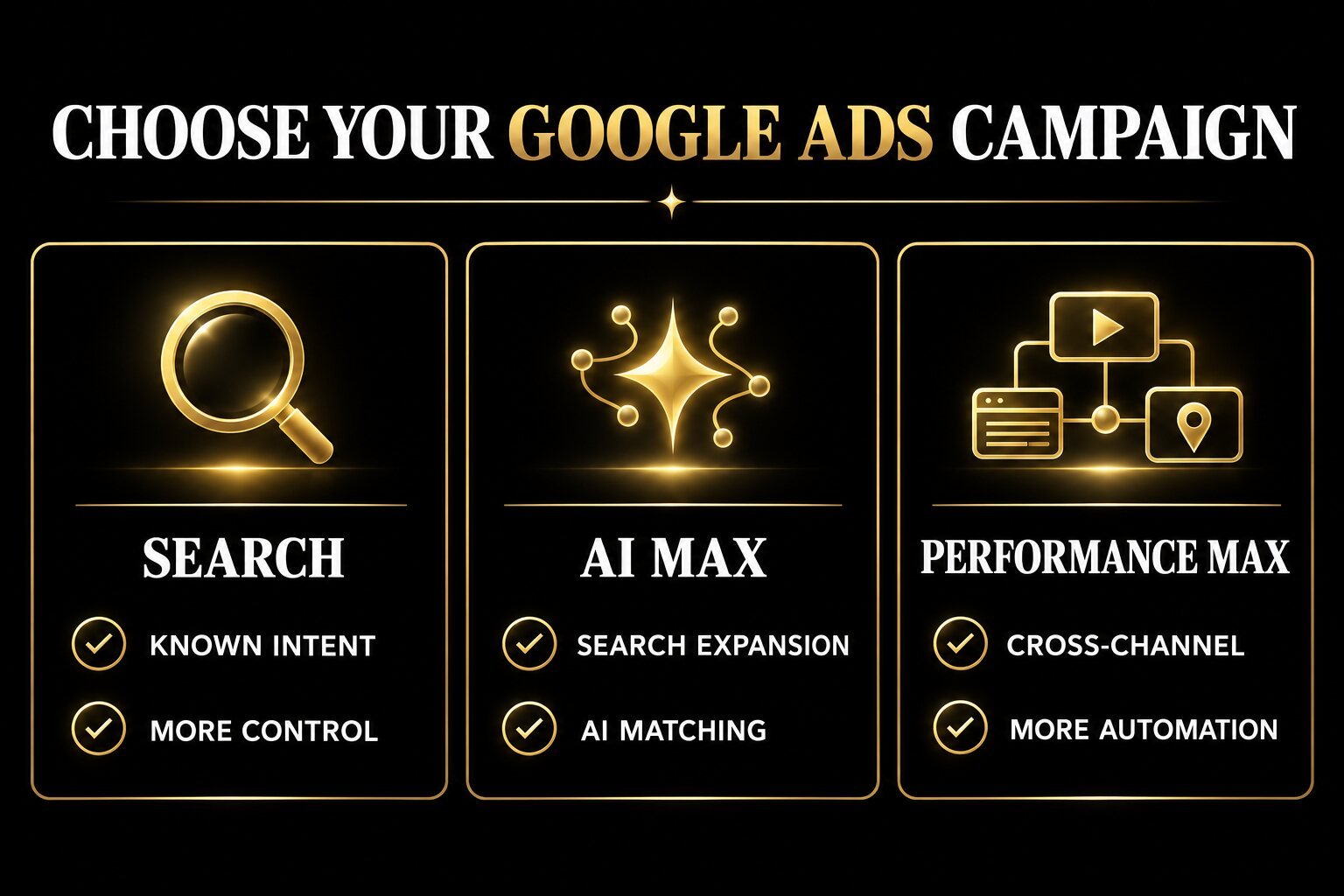
A Search campaign is designed to show text ads when people search for products or services on Google. You organise campaigns and ad groups, choose keywords, write responsive search ads, set bidding and location rules, add negative keywords and send visitors to selected landing pages.
Google’s official Search campaign setup guide explains that keyword match types influence which searches can trigger an ad. Phrase and exact match can narrow the relationship between your keyword and a user’s search, while negative keywords exclude unwanted intent.
Standard Search is often the clearest starting point for a service business because it lets you build around specific buyer intent. A web studio, for example, can separate “WordPress website designer,” “e-commerce website design” and “logo design agency” into focused ad groups with relevant ads and landing pages.
Choose standard Search when:
- You need to capture a small set of high-intent searches.
- Your daily budget is limited and you want a controlled starting point.
- Your offer requires different landing pages or messages for different services.
- You need clear search-term learning before adding more automation.
- You are launching a new account without much conversion history.
What Is AI Max for Search Campaigns?
AI Max is not a separate campaign type. Google defines it as an optimisation layer for an existing Search campaign. It combines search-term matching and asset optimisation features to find additional relevant queries, tailor ad text and, when enabled, select a more relevant page from your website.
According to Google’s AI Max documentation, search-term matching can use broad match and keywordless technology, learning from your keywords, ads and URLs. AI Max also includes controls such as brand settings and locations of interest. Text customisation and Final URL expansion can adapt assets and landing-page selection to the user’s intent.
This makes AI Max useful when your manually selected keyword list is missing valuable long-tail or conversational searches. However, it is not a cure for poor fundamentals. Google specifically notes that AI Max will not be effective when the campaign is limited by budget. It also relies heavily on the quality of your website, conversion tracking and existing campaign inputs.
Choose Search with AI Max when:
- Your Search campaign already produces useful conversion data.
- You want to reach relevant queries that your current keyword list misses.
- Your website has strong, clearly separated service or product pages.
- You can review search terms, landing pages and generated assets regularly.
- You have enough budget to test expansion without starving proven demand.
In 2026, AI Max is also becoming more central to Google’s Search workflow. Google’s updated transition notice says automatically created assets and campaign-level broad match settings begin moving into AI Max from September 2026, while the Dynamic Search Ads sunset and automatic upgrade were extended to begin in February 2027. Check the latest official AI Max transition announcement before changing a legacy account.
What Is Performance Max?
Performance Max is a separate, goal-based campaign type. Google says it can access Search, YouTube, Display, Discover, Gmail and Maps inventory from one campaign. You provide conversion goals, budget, audience signals, text, images, video and—where relevant—a product feed. Google AI then automates bidding, placement and creative combinations to pursue conversions or conversion value.
The official Performance Max guide recommends it when a business has specific sales or lead goals, wants access to all Google channels and is willing to let the system find opportunities beyond keyword-based Search.
Performance Max can be powerful for e-commerce businesses with clean Merchant Center feeds, reliable revenue data and strong assets. It can also support lead generation, but lead quality must be measured—not merely form volume. If spam, accidental calls or low-value enquiries are counted as equal conversions, automation may optimise toward the wrong outcome.
Choose Performance Max when:
- You have accurate primary conversion actions and meaningful values.
- You want to find customers across several Google channels.
- You can supply persuasive text, images, logos and video.
- Your e-commerce feed or service landing pages are complete and current.
- You can judge performance by qualified leads, revenue or profit—not clicks alone.
AI Max vs Performance Max vs Search Campaigns: Detailed Comparison
| Decision factor | Standard Search | Search with AI Max | Performance Max |
|---|---|---|---|
| Campaign type | Search | Search with an AI feature suite enabled | Separate cross-channel campaign |
| Primary inventory | Google Search and selected Search partners | Google Search and selected Search partners | Search, YouTube, Display, Discover, Gmail and Maps |
| Targeting foundation | Keywords, match types, audiences and settings | Keywords plus expanded and keywordless query matching | Goals, data, feeds, audience signals, assets and AI |
| Creative needs | Mainly responsive search-ad assets | Search assets plus optional AI text and URL optimisation | Text, images, logos and video across formats |
| Advertiser control | Most direct structural control | Search structure with additional automation and controls | More cross-channel automation and broader allocation |
| Best first use | Capturing known, high-intent demand | Expanding proven Search campaigns | Finding incremental conversions across Google |
| Common risk | Overly narrow reach or labour-intensive management | Expansion before tracking, pages or budget are ready | Poor-quality inputs steering automation toward weak outcomes |
Can You Run Search, AI Max and Performance Max Together?
Yes. Because AI Max lives inside Search, a business can run one or more Search campaigns—with AI Max activated selectively—alongside Performance Max. The more important question is whether each campaign has a clear role.
- Protect known demand: Use Search for important service, product and brand queries where message and landing-page control matter.
- Expand Search intelligently: Test AI Max in a campaign with enough data and budget, using brand and URL controls where appropriate.
- Find incremental demand: Use Performance Max for cross-channel conversion growth, supported by quality creative and accurate values.
Google’s campaign interaction rules can change and include exceptions. Its current Performance Max guidance says an eligible exact-match keyword in Search is generally prioritised over Performance Max for an identical query, although a budget-limited Search campaign can create exceptions. Avoid relying on campaign names or assumptions; review search-term, channel and conversion reporting in the actual account.
A Practical Setup for a Small Business
1. Fix measurement before choosing automation
Mark only meaningful actions as primary conversions. For lead generation, connect form, call and CRM outcomes where possible so a qualified enquiry is distinguishable from spam. For e-commerce, confirm purchase value, currency, refunds and feed accuracy. No campaign type can compensate for misleading data.
2. Match each search intent to the right page
Do not send every ad to the home page. A visitor searching for logo design should reach a page about logo and branding work; a visitor seeking an online shop should see a relevant e-commerce offer. Review these landing-page design mistakes before paying to send more traffic, and use professional content and copywriting to make the offer clear.
3. Build a controlled Search baseline
Separate themes, write specific ads, add negative keywords and check search terms. This baseline reveals which services, messages and landing pages actually convert. It also gives AI Max stronger inputs later.
4. Test AI Max without hiding the comparison
Choose a campaign with stable tracking, document the date and settings, and monitor incremental queries, CPA or ROAS, lead quality, landing-page selection and generated assets. Do not judge the result after only a few clicks. At the same time, do not leave irrelevant expansion running simply because the feature is automated.
5. Add Performance Max only with complete assets
Supply assets that reflect your actual brand and offer. Weak or inconsistent visuals make it harder to produce credible combinations across placements. A documented brand style guide and professionally prepared ad creative system can improve consistency across formats.
Common Google Ads Mistakes to Avoid in 2026
- Using all conversions as equal: Optimising for low-quality leads can make dashboard numbers look better while revenue falls.
- Turning on automation before fixing the website: Final URL expansion cannot transform a confusing page into a persuasive offer.
- Splitting a small budget across too many campaigns: Each campaign may receive too little data to learn or prove value.
- Comparing campaigns by click-through rate alone: The business outcome is qualified demand, sales and profit.
- Ignoring generated assets: Advertisers remain responsible for accuracy, compliance and brand suitability.
- Making several major changes together: If budget, bidding, targeting and creative all change at once, you cannot tell what caused the result.
- Treating Google’s averages as a promise: Platform benchmarks and reported uplifts do not guarantee performance for an individual account.
Frequently Asked Questions
Is AI Max replacing Search campaigns?
No. AI Max is activated within Search; it is not a replacement campaign type. It changes and combines certain targeting and asset-optimisation capabilities while retaining the Search campaign structure.
Is Performance Max better than Search for small businesses?
Not automatically. Search may be a better starting point for a small service business with limited budget and a narrow set of high-intent queries. Performance Max becomes more useful when the business has trustworthy conversion data, enough budget and suitable assets for multiple channels.
Should a new Google Ads account turn on AI Max immediately?
A new account can use AI Max, but a controlled baseline is often easier to diagnose. If tracking, page quality or offer positioning is uncertain, fix those foundations first and introduce broader automation as a measured test.
How long should a campaign test run?
There is no universal number of days. The test needs enough relevant conversions to evaluate the chosen bidding goal and enough time to account for conversion delay. A low-volume B2B campaign may need much longer than a high-volume online shop. Predefine the budget, primary metric and review date before starting.
Final Recommendation
When comparing AI Max vs Performance Max vs Search campaigns, choose the simplest structure that can answer your business question. Use standard Search to capture and understand known demand. Add AI Max to a well-built Search campaign when you want controlled expansion. Add Performance Max when accurate conversion signals and strong creative assets justify cross-channel automation.
The Visual Spark helps businesses connect advertising strategy with the pages, copy and visuals required to convert traffic. Explore our digital marketing services, improve your destination pages with professional website design, view all creative services or contact us to discuss a clearer growth plan.
Leave A Comment