

AI-generated ads vs human-directed creative is not a contest with one permanent winner. AI can produce more variations in less time, but a skilled human still has to decide what the audience cares about, which promise is credible, how the brand should feel and what deserves to be tested. In 2026, the strongest conversion system is usually a hybrid: human insight sets the direction, AI accelerates production, and real campaign data selects the winner.
This guide compares both approaches without the hype. You will learn where each one performs best, what actually affects conversion rate, how to avoid generic or inaccurate creative, and how to build a repeatable workflow for Meta Ads, Google Ads and other paid channels.
AI-Generated Ads vs Human-Directed Creative: The Short Answer
Use AI when you need speed, variations, localisation, resizing or rapid concept exploration. Use human direction when the work requires customer insight, original positioning, emotional judgement, brand consistency, product accuracy or compliance. For most businesses, use both.
An AI tool can generate an image, headline or background. It cannot independently guarantee that the idea is strategically useful, the claim is true, the product is represented correctly or the ad matches the landing page. That responsibility remains with the advertiser and the people directing the campaign.
| Factor | AI-generated creative | Human-directed creative |
|---|---|---|
| Production speed | Excellent for quick variations | Slower when every asset is built manually |
| Strategic insight | Depends heavily on the prompt and inputs | Stronger when informed by research and experience |
| Brand judgement | Can imitate rules but may miss nuance | Better for taste, consistency and context |
| Original proof | Cannot replace real reviews, results or product evidence | Can select and frame authentic proof |
| Scale | Useful for formats, crops and message variants | Useful for setting the creative system and priorities |
| Quality control | Requires careful review | Provides accountable review and approval |
What Does “AI-Generated” Really Mean in Advertising?
AI-generated advertising can include copy suggestions, new image concepts, background replacement, image expansion, video variations, voice, translation, automatic resizing and platform-specific enhancements. It does not have to mean a fully synthetic ad created from one prompt.
Platforms already offer these capabilities inside campaign workflows. Meta Advantage+ creative can generate and enhance variations for Meta placements. Google also provides generative tools for campaign assets, while warning advertisers to review generated content for accuracy, policy compliance and applicable law before publishing it.
That distinction matters: AI is a production capability, not a marketing objective. The objective is still to create a relevant message that earns attention from the right buyer and moves that person towards a valuable action.
What Actually Makes an Ad Convert?
Customers do not convert simply because an ad was made by AI or by a designer. They respond to the complete proposition. Before judging the tool, examine these seven conversion factors:
- Audience–offer fit: Is the offer genuinely useful to the people seeing it?
- Message: Does the ad make the benefit clear quickly?
- Creative hook: Does the first frame, headline or visual interrupt passive scrolling?
- Proof: Are there credible reviews, demonstrations, outcomes or reasons to believe?
- Message match: Does the landing page continue the same promise and visual story?
- Friction: Is the next step easy on mobile, fast and appropriate for the buyer’s intent?
- Measurement: Are the correct conversions being tracked well enough to guide optimisation?
If clicks arrive but sales do not, changing the image generator may not solve the real problem. Our guide to Facebook ads getting clicks but no sales explains how to diagnose targeting, offer, landing-page and tracking gaps before spending more.
Where AI-Generated Ads Have a Real Advantage
1. Faster creative exploration
A clear brief can become several visual directions or headline angles quickly. This helps a small team explore possibilities before investing time in polished production. The value is not publishing every output; it is finding promising directions faster.
2. More useful variations
Campaigns often need square, portrait, landscape and vertical assets, plus different hooks for audience segments. AI-assisted tools can speed up background extensions, crops and text variations. This is especially useful when a strong core concept already exists.
3. Localisation and adaptation
AI can help create first drafts for different markets, reading levels or customer contexts. A human should still review language, cultural cues, pricing, offers and legal meaning. Literal translation is not the same as local relevance.
4. Reducing repetitive production work
Resizing, isolating objects, generating background options and preparing rough storyboards can consume valuable creative time. Automating parts of that work gives the team more time for positioning, concepts, editing and testing.
Where Human Direction Remains Essential
Customer insight and positioning
High-performing creative begins with a useful observation: what the customer wants, fears, doubts or misunderstands. That insight can come from sales calls, reviews, customer interviews, search queries and campaign data. AI can organise those inputs, but people must decide which tension is meaningful and which promise the business can honestly deliver.
Brand distinctiveness
Without strong direction, generated assets tend to drift towards familiar compositions, polished stock-like scenes and interchangeable language. A documented brand style guide gives AI and human creators the same boundaries for colour, typography, imagery, voice and prohibited treatments.
Accuracy, rights and responsible claims
Generated visuals may alter packaging, product details, anatomy, scale or context. Generated copy can invent features or make an unapproved claim sound convincing. Google states that generative assets are not guaranteed to be approved and should be checked for accuracy, misleading content, policy issues and legal compliance. In short, generation never removes advertiser responsibility.
Taste and final editing
Good direction involves subtraction. A human art director can remove visual noise, strengthen hierarchy, recognise when an idea feels off-brand and choose the version that communicates fastest. The goal is not to show how much the tool can make; it is to publish the clearest persuasive asset.
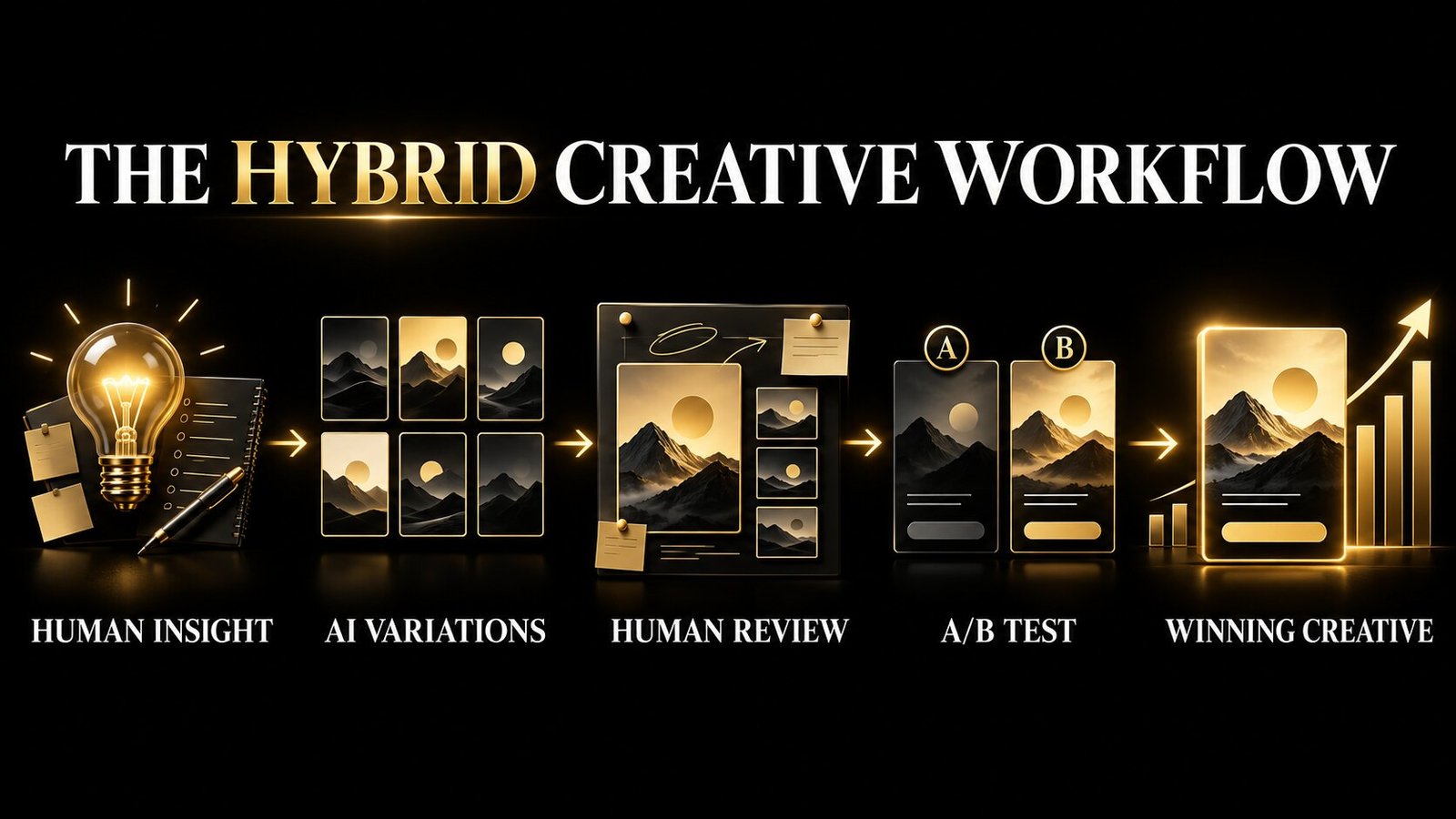
The Hybrid Creative Workflow That Works in 2026
Step 1: Start with evidence, not a prompt
Collect customer language, objections, best-selling benefits, campaign results and competitor patterns. Define one audience, one problem and one desired action. This prevents the project from becoming a collection of attractive but disconnected images.
Step 2: Write a human-approved creative brief
The brief should specify the objective, audience, offer, single-minded message, proof, call to action, placement, brand rules and claims that must not be made. If the brief is vague, faster production only creates more vague ads.
Step 3: Use AI for controlled exploration
Generate variations around distinct hypotheses: a pain-led hook, a benefit-led hook, a demonstration, a testimonial treatment or an objection answer. Keep the product facts and offer fixed. The prompt should include brand constraints and the intended placement.
Step 4: Apply human art direction
Review every option for clarity, originality, visual hierarchy, accuracy and brand fit. Correct hands, text, packaging, scale, shadows and inconsistent details. Replace synthetic proof with genuine customer evidence. A professional social media ad design process turns raw variations into a coherent campaign rather than a mixed collection of styles.
Step 5: Prepare platform-native versions
Adapt the approved concept for each placement instead of merely cropping it. A vertical Story needs a different visual rhythm from a feed image, responsive display asset or search ad. Keep important elements inside safe zones and ensure the message remains understandable without sound.
Step 6: Run a preflight review
- Verify every product detail, price, claim and disclaimer.
- Check brand assets, usage rights and platform policies.
- Confirm legibility on a real mobile screen.
- Match the creative promise to the landing page.
- Add meaningful alt text where the placement supports it.
- Confirm conversion tracking before launch.
Step 7: Test hypotheses, not random designs
Use a simple three-way test: the current human-directed control, one AI-assisted variation and one hybrid concept refined by a human. Change one major variable at a time, such as the hook or proof format. Keep audience, offer and optimisation settings stable enough to interpret the result.
Step 8: Learn, refresh and document
Record which message, opening frame, format and proof performed best. Use those findings in the next brief. AI becomes far more valuable when it works from a growing library of real brand knowledge rather than isolated prompts.
How to Measure Which Creative Actually Wins
Do not crown a winner on click-through rate alone. Match the metric to the campaign goal:
- Awareness: qualified reach, video hold rate and incremental brand outcomes where available.
- Consideration: landing-page views, engaged sessions and meaningful micro-conversions.
- Lead generation: cost per qualified lead, booking rate and sales acceptance—not raw form count.
- Ecommerce: purchase conversion rate, customer acquisition cost, revenue and contribution margin.
Also check whether the winning ad brings the right customers. A sensational synthetic visual may produce cheap clicks but weak purchase intent. Compare downstream quality, allow a fair testing period and avoid making decisions from tiny samples. For channel selection, see our comparison of Google Ads vs Facebook Ads for small businesses.
Common AI Ad Creative Mistakes
- Generating before researching: volume cannot compensate for a weak audience insight.
- Publishing the first output: raw generation is a draft, not an approval process.
- Creating fake proof: invented testimonials, results or product use damage trust.
- Losing brand consistency: every new prompt creates a different visual world.
- Testing too many variables: you cannot tell whether the hook, design, copy or offer caused the result.
- Ignoring the destination: an excellent ad cannot rescue a slow or mismatched landing page.
- Optimising for cheap engagement: likes and clicks are not automatically profitable outcomes.
So, Should Your Business Use AI-Generated Ads?
Yes—if AI is used as part of a controlled creative system. It is especially useful for businesses that need more testing velocity but have limited production capacity. It is less useful when no one owns the strategy, brand standards, accuracy review or measurement plan.
Choose human-directed creative when the campaign launches a new brand, explains a complex offer, uses sensitive claims, depends on authentic photography or must establish a distinctive visual position. Choose AI assistance when you already have an approved concept and need thoughtful variations at speed. In many campaigns, the right answer is a human-led system with AI inside it.
Frequently Asked Questions
Do AI-generated ads convert better than human-made ads?
Not automatically. Performance depends on the audience, offer, message, proof, execution, landing page and measurement. A controlled test using the same campaign conditions is the most reliable way to compare creative.
Can I use AI images in Facebook and Instagram ads?
AI-assisted creative can be used, subject to Meta’s advertising standards, product rules and any applicable disclosure or labelling. Review the current platform requirements and verify that the content is accurate and that you have the necessary rights.
Will Google approve every generative AI asset?
No. Google says generated assets are not guaranteed to be approved. All ad content is subject to its policies regardless of how it was created, so advertisers should review assets before use.
How many ad variations should a small business test?
Start with a manageable number that your budget can support. Three clearly different hypotheses are often more useful than dozens of minor variations. Each version should have a reason to exist and a defined learning goal.
Can AI replace an ad designer or creative strategist?
AI can reduce repetitive production and speed up exploration, but it does not replace accountable strategy, customer understanding, art direction or final judgement. It is most effective when a skilled person directs the inputs and reviews the outputs.
Build a Faster Creative System Without Losing Your Brand
The practical conclusion to AI-generated ads vs human-directed creative is simple: let people own the insight, promise, standards and final decision; let AI accelerate the parts that benefit from scale. Then let genuine conversion data—not novelty—decide what earns more budget.
The Visual Spark combines AI-assisted creative support, strategic content and copywriting, and performance-focused design to build campaigns that remain recognisable, accurate and testable. Explore our digital marketing services or contact us to plan your next creative testing system.
Leave A Comment